A deep dive into the architecture, methodology, and extensive validation of FastSurfer's deep-learning neuroimaging pipeline.
FastSurfer is a fast and extensively validated deep-learning pipeline for fully automated processing of structural human brain MRIs. It provides FreeSurfer-conform outputs, enabling scalable big-data analysis and time-critical clinical applications such as structure localization during image acquisition or extraction of quantitative measures.
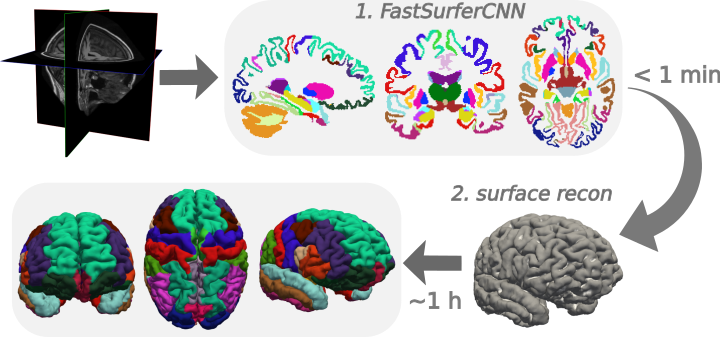
The pipeline is organized into two main stages:
Watch a concise introduction to FastSurfer's design and capabilities.
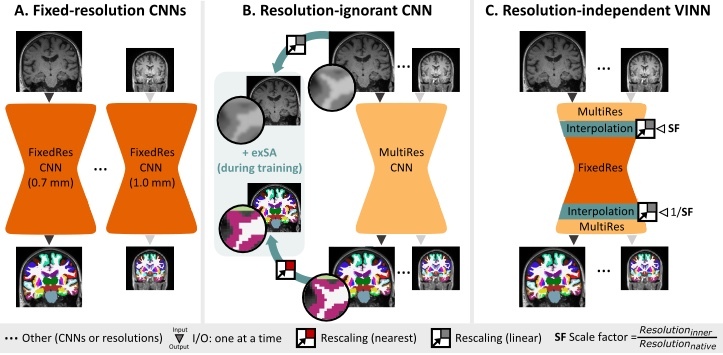
FastSurferVINN (View-Aggregation with Instance Normalization Network) is the current segmentation engine in FastSurfer, introduced in Henschel et al., NeuroImage 2022. It performs whole-brain segmentation into 95 anatomical classes in under one minute and produces outputs fully compatible with FreeSurfer's DKTatlas parcellation.
The architecture uses three fully convolutional networks (F-CNNs) operating on coronal, axial, and sagittal 2D slice stacks — an approach first established in the original FastSurferCNN — combined with competitive dense blocks, competitive skip pathways, and a 7-channel multi-slice input that captures local neighbourhood context.
The central advance in VINN is resolution independence: by replacing batch normalization with instance normalization (IN) and conditioning the network on the input voxel size, VINN adapts its internal representations to the acquisition resolution at inference time. This enables robust, consistent segmentation across protocols ranging from standard 1 mm isotropic acquisitions to high-resolution 0.7–0.8 mm sub-millimeter scans — without any protocol-specific fine-tuning.
The segmentation block also replaces FreeSurfer's built-in corpus callosum detection with a dedicated CC module, avoiding FreeSurfer's known tendency to incorrectly attach the fornix to the CC and providing sub-regional parcellation with local thickness estimates (see FastSurfer-CC below).
Starting from the segmentation, FastSurfer performs a complete surface-based analysis: cortical surface reconstruction, atlas label mapping, and point-wise and ROI thickness analysis — the same outputs as a full FreeSurfer pipeline, but produced in approximately one hour. Having a high-quality segmentation from the outset eliminates several time-consuming FreeSurfer steps, including skull stripping and non-linear atlas registration, and also enables a number of targeted methodological improvements.
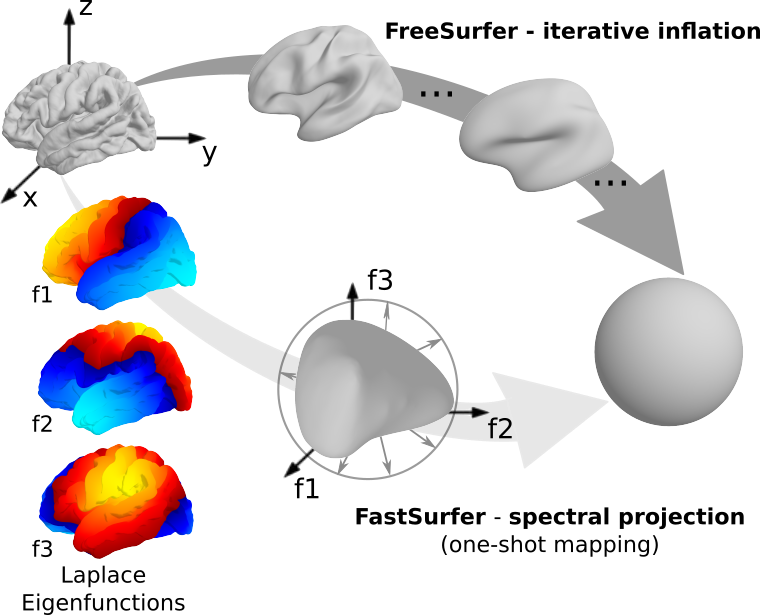
Key improvements over FreeSurfer's surface pipeline:
FastSurfer's modular design enables targeted analysis of specific brain structures, each backed by dedicated peer-reviewed work.
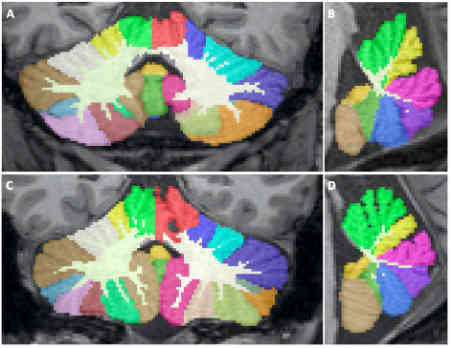
Detailed sub-segmentation of the cerebellum into 28 sub-regions. Validated across scanner sites and cerebellar disease cohorts.
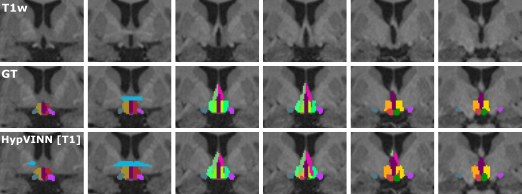
Automated sub-segmentation of the hypothalamus and 7 adjacent structures using a resolution-independent VINN architecture.
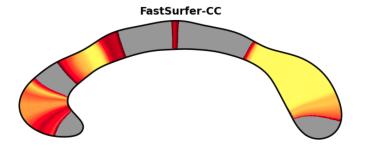
Robust morphometry of the corpus callosum and its five sub-regions — area, thickness, and curvature — derived from the whole-brain segmentation.
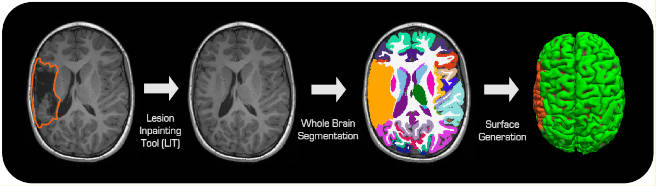
Inpainting module enabling the full surface pipeline on brains with tumors, resection cavities, or other focal abnormalities.
FastSurfer was extensively validated across multiple publicly available datasets. Accuracy and reliability relative to FreeSurfer were established with the original pipeline and carry forward to FastSurferVINN, which additionally extends robust performance to arbitrary acquisition resolutions.
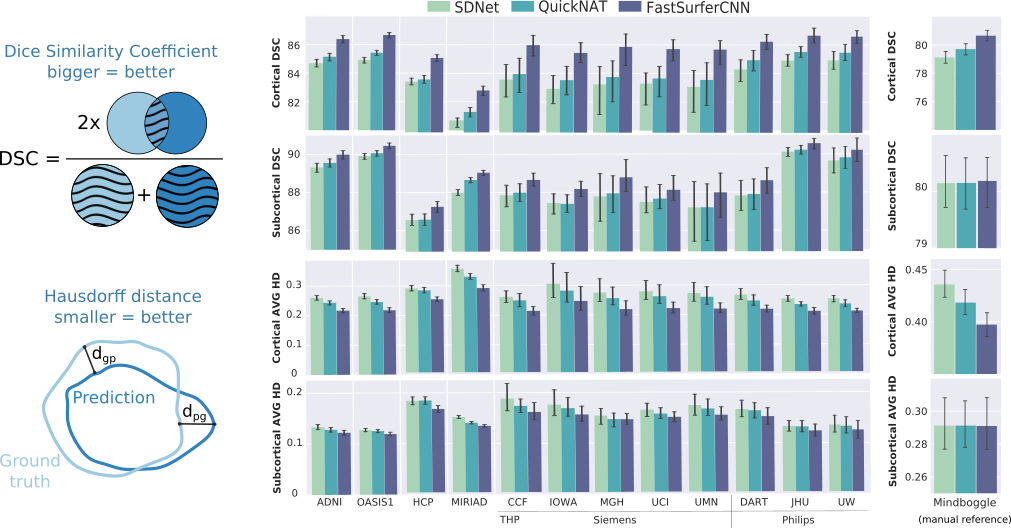
FastSurfer outperforms other deep-learning architectures across five public datasets covering different disease states (OASIS, ADNI, MIRIAD), scanner vendors, age groups, downsampled and defaced images, and alternative T1 imaging protocols. It achieves superior Dice Similarity Coefficients and Hausdorff distances both relative to FreeSurfer and to a manual gold standard (Mindboggle).
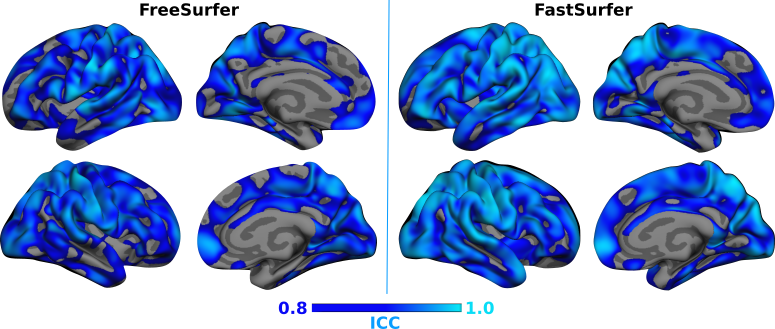
FastSurfer demonstrates high test-retest reliability, with close agreement between thickness and volumetric measurements across 20 test-retest subjects from OASIS1. Intraclass correlation coefficients (ICC) are consistently high, and cortical thickness agreement is improved compared to FreeSurfer.
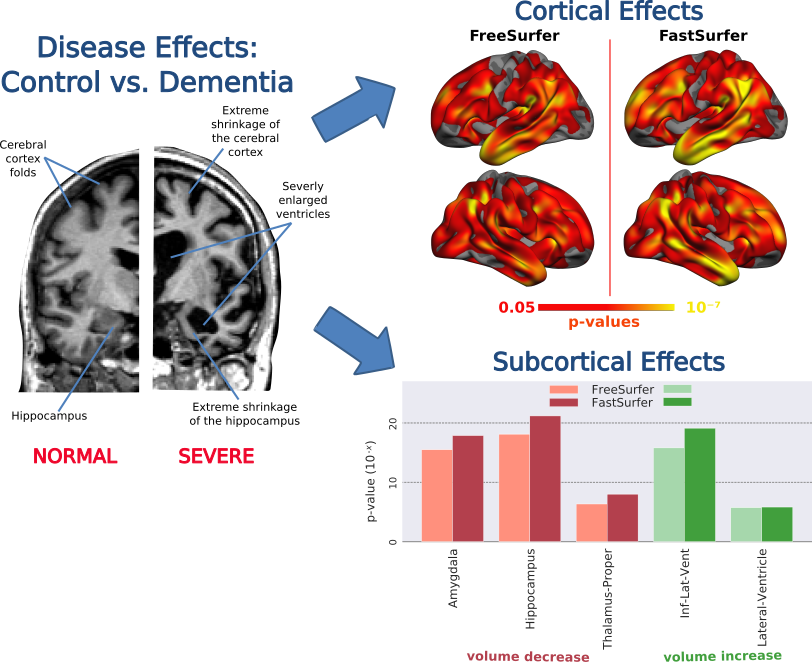
FastSurfer accurately reproduces known disease effects in control vs. dementia cross-sectional group studies. Reduced cortical thickness in regions associated with dementia (e.g. temporal lobes) and subcortical volume differences (e.g. enlarged ventricles, reduced hippocampal volume) are detected with greater sensitivity than FreeSurfer.
Everything you need to use, cite, and learn more about FastSurfer.